Quine-McCluskey Algorithm
Quine-McCluskey Algorithm
Section titled “Quine-McCluskey Algorithm”A comprehensive Python implementation of the Quine-McCluskey algorithm for Boolean function minimization. This algorithm systematically finds prime implicants, essential prime implicants, and generates all minimum sum of products forms for Boolean functions with up to 26 variables.
Algorithm Execution Examples
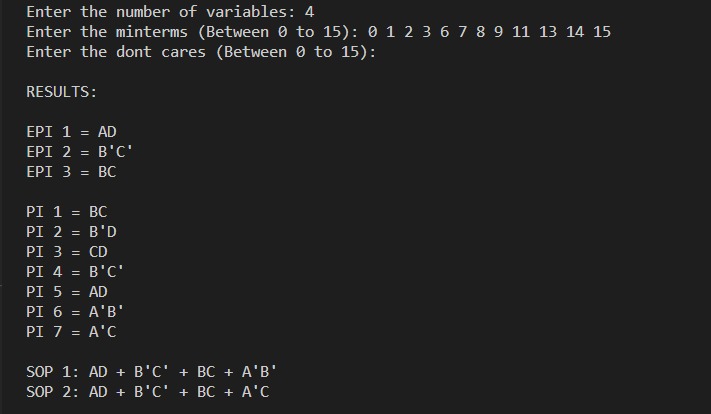
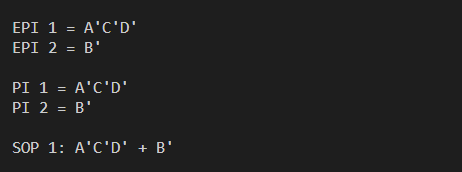
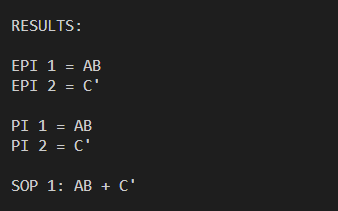
Theoretical Foundation
Section titled “Theoretical Foundation”The Quine-McCluskey algorithm is a tabular method for minimizing Boolean functions. It provides an exact solution for finding the minimal sum of products (MSOP) representation, making it fundamental to digital logic design and optimization.
Mathematical Background
Section titled “Mathematical Background”Given a Boolean function , the algorithm finds the minimal expression:
Where each is a prime implicant and the sum represents logical OR operation.
Algorithm Phases
Section titled “Algorithm Phases”The algorithm operates in two main phases: finding prime implicants and selecting essential ones for minimal coverage.
Phase 1: Prime Implicant Generation
Section titled “Phase 1: Prime Implicant Generation”- List Minterms: Enumerate all minterms where function evaluates to 1
- Group by Ones: Group minterms by number of 1s in binary representation
- Combine Terms: Iteratively combine terms that differ by exactly one bit
- Mark Combined: Remove terms that were successfully combined
- Repeat: Continue until no more combinations possible
- Extract Primes: Unmarked terms are prime implicants
Phase 2: Prime Implicant Selection
Section titled “Phase 2: Prime Implicant Selection”- Coverage Table: Create table showing which prime implicants cover which minterms
- Essential Primes: Identify prime implicants that uniquely cover minterms
- Select Essential: Include all essential prime implicants in final expression
- Cover Remaining: Select minimal subset of remaining primes for complete coverage
- Generate Solutions: Produce all minimal sum of products forms
Implementation Features
Section titled “Implementation Features”The implementation provides both interactive and programmatic interfaces with comprehensive output analysis.
Supported Operations
Section titled “Supported Operations”- Prime Implicant Discovery: Systematic finding of all prime implicants
- Essential Prime Identification: Automatic detection of essential prime implicants
- Multiple Solutions: Generation of all minimum sum of products forms
- Don’t Care Handling: Support for don’t care conditions in specification
- Variable Limitation: Support for up to 26 variables (A-Z)
Usage Modes
Section titled “Usage Modes”Interactive Mode
Section titled “Interactive Mode”python main.pyProvides step-by-step guided input with real-time visualization of the minimization process.
Batch Mode
Section titled “Batch Mode”python main.py <variables> <minterms> -d <dont_cares>Example with don’t cares:
python main.py 4 0 1 2 3 4 -d 5 6 7 8Example without don’t cares:
python main.py 3 0 4 2 6 7Algorithm Complexity
Section titled “Algorithm Complexity”The computational complexity grows exponentially with the number of variables, making it suitable for moderate-sized problems.
Time Complexity Analysis
Section titled “Time Complexity Analysis”- Minterm Generation: for n variables
- Combination Phase: where m is number of minterms
- Coverage Analysis: where p is number of prime implicants
- Solution Generation: Exponential in worst case for multiple minimal solutions
Space Complexity
Section titled “Space Complexity”- Storage Requirements: for complete truth table representation
- Intermediate Terms: during combination phase
- Result Storage: for prime implicants and minimal solutions
Applications
Section titled “Applications”The Quine-McCluskey algorithm is fundamental to:
- Digital Logic Design: Minimization of combinational logic circuits
- Computer Architecture: Optimization of arithmetic and logic units
- VLSI Design: Reduction of transistor count in integrated circuits
- Formal Verification: Analysis of Boolean specifications
- Educational Tools: Teaching of logic minimization concepts
Comparison with Other Methods
Section titled “Comparison with Other Methods”The Quine-McCluskey algorithm offers distinct advantages compared to alternative minimization techniques.
vs. Karnaugh Maps
Section titled “vs. Karnaugh Maps”Quine-McCluskey Advantages:
- Scalability: Works with more than 6 variables systematically
- Algorithmic: Suitable for computer implementation
- Completeness: Guaranteed to find minimal solutions
- Multiple Solutions: Finds all minimal expressions
Karnaugh Map Advantages:
- Visual Intuition: Easier for small numbers of variables
- Manual Speed: Faster for 2-4 variable problems
- Pattern Recognition: Human-friendly for simple cases
vs. Espresso Algorithm
Section titled “vs. Espresso Algorithm”Quine-McCluskey:
- Exact Method: Guaranteed minimal results
- Educational Value: Clear theoretical foundation
- Systematic: Well-defined algorithmic steps
Espresso:
- Heuristic: Faster for large problems
- Practical: Better for real-world circuit sizes
- Optimization: Additional heuristic improvements
Implementation Details
Section titled “Implementation Details”The Python implementation uses efficient data structures and algorithms:
- Bit Manipulation: Fast binary operations for term combination
- Set Operations: Efficient coverage analysis
- Recursive Search: Exhaustive solution enumeration
- Memory Optimization: Minimal intermediate storage
Usage Examples
Section titled “Usage Examples”The algorithm handles various Boolean function specifications effectively.
Example: 4-Variable Function
Section titled “Example: 4-Variable Function”Input specification for function with minterms (0,1,2,3,4) and don’t cares (5,6,7,8):
python main.py 4 0 1 2 3 4 -d 5 6 7 8Output provides:
- Prime implicants with binary representations
- Essential prime implicants identification
- All minimal sum of products forms
- Coverage analysis tables
Example: 3-Variable Function
Section titled “Example: 3-Variable Function”Simple function without don’t cares:
python main.py 3 0 4 2 6 7Demonstrates algorithm operation on smaller problem spaces with clear visualization of each step.
Limitations and Extensions
Section titled “Limitations and Extensions”Current Limitations:
- Variable Count: Maximum 26 variables due to naming convention
- Exponential Growth: Becomes impractical for very large functions
- Memory Usage: Truth table storage for large variable counts
Potential Extensions:
- Heuristic Pruning: Early elimination of non-essential terms
- Parallel Processing: Distributed computation for large problems
- Incremental Updates: Efficient modification of existing solutions
- Output Formats: Support for VHDL, Verilog, and other HDLs
Implementation Notes
Section titled “Implementation Notes”This implementation serves as both an educational tool and a practical utility for digital logic design, providing clear visualization of algorithmic steps and comprehensive analysis of Boolean function minimization.